Monday, July 22, 2013

Mix 2008 I

Do any of you remember mix tapes? Or even mix CDs? It feels a generation ago that any of us were making these compilations. With the advent of the iPod and deluge of MP3 players afterward, the compilation CD was rendered obsolete and a memory of old tech.

There's a problem though, in that many of our cars don't have connections for digital music players. Sure, mostly all of them do now, but you go back a few years and they all lack that AUX jack that makes it all come together. Instead, we're stuck with a single disc CD player and the radio. My car is a 2008 model and has that AUX jack so I don't have much of an excuse to pop in a CD anymore, aside from that fact that it is infinitely more convenient than getting the cable and everything plugged in (especially while driving - a big no no) and navigating the interface to start playing something. With a CD, I pull it out of the visor storage area and pop it in, the music is playing immediately. So there is much to be said for the CD mix these days, although I recognize I am in the minority here.

It's been a few years since I've made a mix CD. The one that has stayed in my car and gotten the most play is entitled MIX 2008 I. Sadly, there was never a II, or even a follow up the next year. The only time I remember actually burning another mix is when my friend and I drove to Chicago. I created a couple of playlists from my iTunes collection using Genius. So based on one track, I would simply burn the remainder of Genius recommended tracks to the disc. We never listened to them. They are lost.

MIX 2008 I is representative of a transition from a car without AUX input to one with, and an ushering in of the new, digital player era. On long trips I no longer needed a binder of discs, but simply a cradle to put my iPod in and that 3.5mm cable to connect to my car. This also brought on the era of podcasts, as talk radio on a multi-hour drive was always important, and sometimes the CBC just wasn't that interesting.

I wanted to share the track listing of MIX 2008 I

01. Swan Lake - Widow's Walk
02. Sufjan Stevens - We Are What You Say
03. Franz Ferdinand - Tell her Tonight
04. Placebo - The Bitter End
05. British Sea Power - It Ended on an Oily Stage
06. Interpol - Roland
07. The Strokes - Reptilia
08.
09. The Killers - On Top
10. Kaiser Chiefs - Ruby
11. The National - Mr. November
12. Panda Bear - Comfy In Nautica
13. Andrew Bird - Fake Palindromes
14. Peter Bjorn and John - Let's Call it Off
15. Radiohead - Reckoner
16. Spoon - Laffitte Don't Fail Me Now
17. The Decemberists - Summersong
18. Barenaked Ladies - Lover's in a Dangerous Time
19. Black Rebel Motorcycle Club - Mercy

There are no liner notes, no track listing on the CD: I used Shazam to recognize most of the track names. It failed me on track eight, which I'm not surprised at. It was an impulse addition of a track I thought I enjoyed, but it's nigh implorable. For the past five years I've pressed the skipped button more times than I care to remember. The rest of the album, however, is borderline genius.

We start off with Swan Lake moaning; I've had friends wrinkle their faces in disgust and confusion as this title is a bit different to begin with. However, it smooths out into a more typical song and easily transitions into the other tracks. Mind you, it was not a completely random order of tracks either: I tried my best to ensure they come into one another, so that you are not too startled or taken aback by a change in pace. And this is proven in the last few tracks of the album, which wind you down from the earlier, more aggressive tunes that run from Tell Her Tonight through to Ruby. Mr. November by the National has a way to transition from powerful yet subdued, which sets up the second half of the album. And finally, the compilation finishes on one of my favourite tunes, and what I think is the perfect ending.

After five years, it's a very relevant mix of great music.

And now you can enjoy it too, if you're on Rdio that is. Or perhaps I'll take the time and link to the songs on Youtube, if possible.
Saturday, July 20, 2013

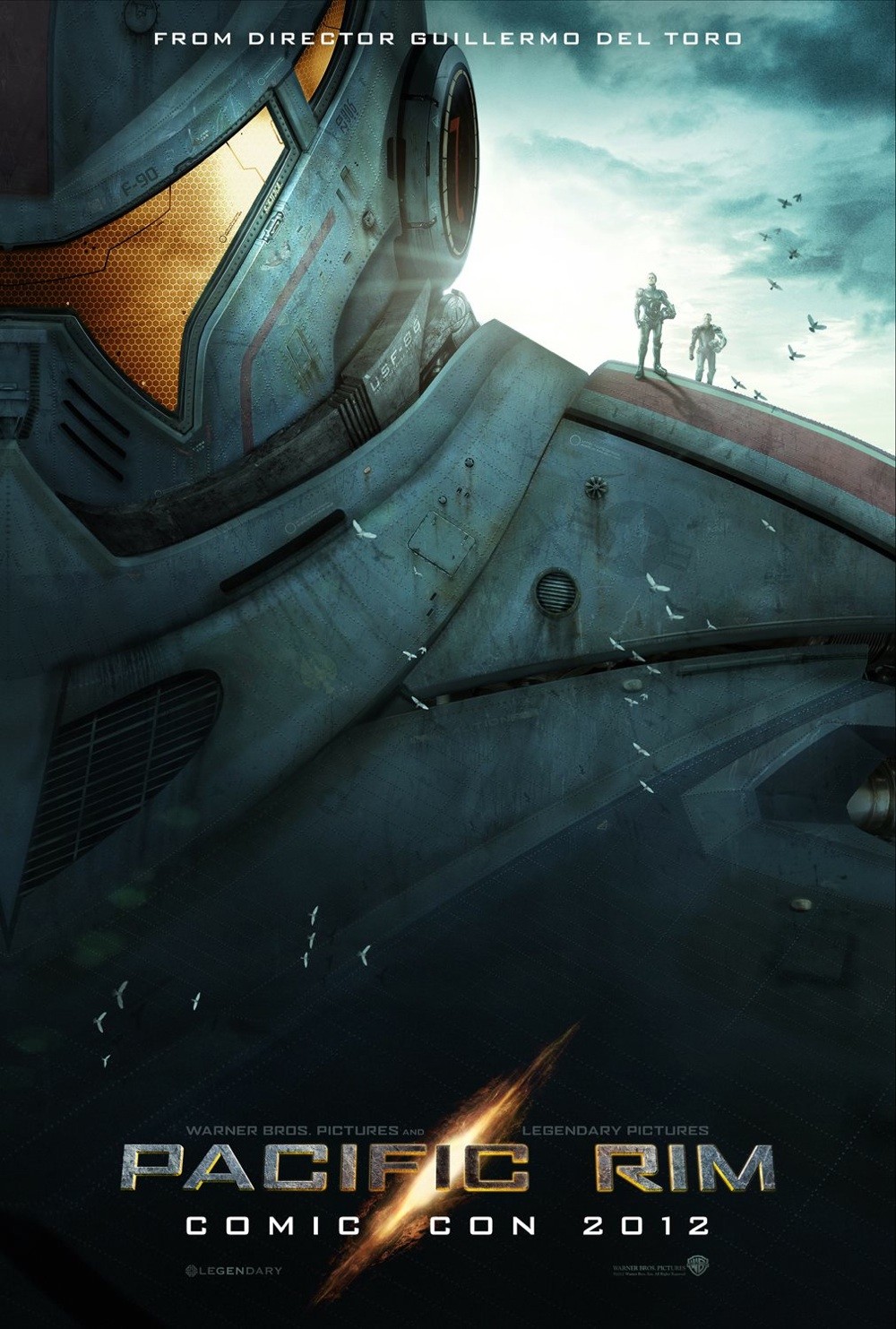
Pacific Rim

Every once in a while, a movie comes along that demands that the group gets together and make it into an actual event. It can be difficult these days to the point where we barely try to get everyone on board to see one movie at a specific time, and it seems to work out now that once or twice a year, we make it happen. Last summer, Looper was the movie that got us all out. This year, Pacific Rim.

And unlike Looper, we all walked away excited and happy with the movie. Was there any doubt though? Really? Right from the initial teaser trailers, we were all hooked: giant robots fighting giant monsters. That type of movie - in my opinion - has been long overdue for quite some time. Growing up, I watched a lot of Godzilla movies with my dad, so I'm partial to the giant monster thing. Sprinkle in some robots and you have a film that taps directly into all of our childhoods favourite memories. We gobbled it up.

There is lots of fan service here: the giant monsters, known as kaiju, begin invading Earth through a portal at the bottom of the Pacific Ocean. We can defend ourselves but it's not easy, so we create giant, human controlled robots called jaeger and engage them in a straight up brawl. That's right, the jaeger are equipped with rockets and plasma cannons, but it's the fists that do all the talking. It's almost comical, if it wasn't so awesome.

Each jaeger is piloted by two people, whose minds are joined together - the task of piloting and operating these giant mecha is too much for one brain to handle, so we threw two at it. The melding of minds is referred to as drifting, as the initial meld has both users going through the others memories and feelings. They become linked in a way that any physical communication can't match. In the previews, I thought the idea was a bit silly, but in practice it makes sense and actually adds weight to the story: imagine sharing the mind of somebody as they die, then going on to share your mind with another and have that individual experience those through you as well. It's interesting, and is significant when two pilots simply nod at one another later on: no words need to be spoken because they know exactly where they stand.

Anyway, the combat - which we all came here to see - is superb. Guillermo del Toro doesn't fall into the modern day action movie pitfall of too much editing and quick cutting to see the action: the two towering behemoths duke it out in gorgeous CGI glory in near slow motion. We get to see it all, and I love it every second of it. Kaiju and jaeger alike have a real sense of being, of some real weight on screen, which can often be lost in CGI creations. The designs of the robots and monsters practically beg for trading cards, action figures and more. Cities get destroyed as they should, but it doesn't feel excessive. Seeing Man of Steel recently, I balked at the city destruction caused by two super powered tiny men (aliens I suppose). There is much less destruction on screen here between two giants, but it feels proper, if that's possible.

There are faults of course: kaiju and jaegers change size constantly to fit the needs of the scene; the acting is flat but acceptable, and the story is not wholly original. But these are minor complaints that hold little significance to the enjoyment of the film. We came to see monsters versus robots, and that's exactly what we got. It's fun, loud, bombastic and the perfect film to see in theatres with a bunch of friends.

Wednesday, July 17, 2013

Never Let Me Go

Never Let Me Go is a film that is destined to slip under the radar of everyone, and it certainly did on mine. Asing its praises, but is more subtle in its accolades, than I take notice. And I grab it. Unfortunately that's only one step of the process, as having the movie and actually sitting down to watch it is another issue altogether. I was browsing my collection last night and saw the film there, and wondered: what is this? The brief description coined it as a science fiction film, which immediately grabs my attention. This, with a combination of some of the actors in it (Carey Mulligan, Andrew Garfield) and the fact that I at one point added it to my collection, was reason enough to hit play.
Not until I read a small blurb in a magazine or a forum post that doesn't quite

I was confused during the first act, but intrigued. The film opens with a few lines of text stating that in the 1950s, a medical breakthrough has allowed the human life expectancy to surpass 100 years. We start the film in the '60s, following a group of children in a school that seems a bit different than your typical school. They are encouraged to produce art, more than other subjects, and they seem to be isolated. Scary stories of what happens to children when they go beyond the fence keep everyone inside and guessing, almost living in a bit of fear if it wasn't for the fact that every child seems pretty happy. We're introduced to these stories through the addition of a new teacher to the schools ranks, who after a short time tells the students what their purpose is in life. She tells them to live their lives to the fullest with this knowledge, and is promptly fired from the school.

[Spoilers throughout the rest]

It's quite unsettling: the children are there to provide organ donations as they enter adulthood, and their own life expectancy is about thirty years. Typically they make two or three donations, at which point they complete. The child actors they got here do a brilliant job - apparently they would watch their adult counterparts act, and the adults could model their own acting based on the children. This method comes through brilliantly on screen, as we transition into their late teens/early twenties when the children are now living in The Cottages and we're introduced to our adult actors for the first time. There is a love triangle between Kathy (Mulligan), Tommy (Garfield) and Ruth (Knightley) that begins innocently in childhood and becomes more complex when we jump ahead.

Dejected, Kathy seems to be the odd one out as she follows her own path of becoming a carer - one of the organ donators who accepts the task of consoling other donors as they pass through to completion. She doesn't see the other two for ten years, where the film advances to once more. She then runs into Ruth again, who has just gone through two donations. Her time is nearly up. And so is Tommy's.

I've spent a bit of time basically spoiling the film through plot reveal, but you must understand that there is much more going on here. This isn't about the big reveal in the end, it's about the journey getting there. While this may be a science fiction film, it is a better human story about love, and the journey that we all take to accept our own mortality. This is what really got to me: we have three characters dealing with their fate in their own unique ways. It is something that I have thought about a lot over the past few years, and struggled with. Kathy has accepted her role, and knows that she will complete soon. She understands the bigger picture here: that they are all clones bred for organ harvesting (sounds quite grim, doesn't it?) and has a certain melancholy about the subject. She doesn't look back at her younger romance, she doesn't try to defer the inevitable. But she won't deny them, either. The other two deal with it in their own way, representative of my own feelings: anger, resentment, sadness, acceptance.

It's also difficult not to draw comparisons to The Island, a 2005 explosion fest starring Ewan McGregor and Scarlett Johansson. The first half of that film was very interesting, before it devolved into a generic, extended action chase sequence with enough effects and explosions to numb yourself. The beginning held promise on the ethics of cloning, harvesting parts for the super rich and living in a false, controlled society. Never Let Me Go is set in the real world, where these characters know their purpose and are (for the most part) accepting of it. I could only imagine the rest of society's feelings on these, of which we don't spend much time on at all. The focus is on the three love interests and their story. Suffice to say, the more personal, intimate story wins out here, although both have their place.

Never Let Me Go also advances into the question on whether these people have souls. This is why they are encouraged to produce art as children, and its this creation of art that Tommy undertakes to defer his own donations: if he can produce art that definitively shows that he has a soul, he may be spared. Although the film doesn't address it specifically, we, the audience, know that they do. It's not about art, it's about who they are as people. They act the same way we do, they feel the same way. These clones are equals, if not more. It's summed up beautifully in the last lines of the film, as Kathy ponders whether her fate is any different than those who receive the donations.

Beautifully acted, and wonderfully shot, I would have to recommend to anyone.

Thursday, July 11, 2013

Heavy Rotation

Rdio has taken a bit of a backseat to life these days; with a change in jobs I don't have as many opportunities to put in headphones and set my mind on a task. My fear is that my music listening will fall way behind, so I'm actively trying to keep a few albums open, and Rdio playing a shuffled artist station whenever I can.

So far so good, but I've definitely hit a snag, in that I just keep listening to a few albums that I discovered just a few months ago. This isn't necessarily a bad thing, as its telling of the quality of these albums, right?

I was asked recently what I've been listening to, and this post has been sitting in draft for a while. So here you go, my top four albums this past month!

Sea Wolf - Old World Romance

John Grant - Pale Green Ghosts

Gold & Youth - Beyond Wilderness

Young Galaxy - Ultramarine

Tuesday, July 09, 2013

Six Months of Movies: Part 2: More Movies

I've been awaiting this day anxiously and with a certain giddiness. Six months have passed. That's six more months of movie watching and movie stats to extract from. More comparisons. And it shall be glorious, right?

Last time I chronicled the time period of July 2012 through to December 2012. Check out the post to refresh your memory, if you like. This time around, we'll be going over January 2013 through the end of June 2013. This is exciting.

Fig 1; January 2013 to June 2013

Figure 1, above outlines the total number of movies watched per month. We managed to hit a record high here of 16 in June, which is pretty exciting and a direct result of me doing split movies. This is the practice of watching half a movie one night, then finishing the second night. A part of me thinks this is cheating in some way, that a view should be encapsulated in one sitting. But, that's not how it works here right now. Sixteen may sound like a lot, but it seems to standard for June. You can see that in June 2011 I took in 17 movies, and rest assured there was little splitting going on. Quite simply, June is a major movie month with plenty of new releases coming to theatres. I went at least once a week every week.

Fig 2; 2011 to 2013 comparison

Now we can compare the same period in 2013 to 2011, in figure 2 above. As I mentioned before, June is a monster month for movies, with 16 in 2013 and 17 in 2011. While this year saw a steady decline of movies over the months, 2011 was more up and down. The decline this year is due directly to an increased consumption of video games, specifically: Borderlands. I typically spend my Friday and Saturday nights playing at my buddy's place, where before we would typically take in a movie or two on each of those nights. 

Fig 3; Year 1 to Year 2
A very basic comparison of a full twelve months of movies, from July 2010 to June 2011, and July 2012 to June 2013. Unfortunately I didn't record movies for an entire year; fortunately I started recording at the right time for an even comparison between two years. While figure 3 may illustrate a large gap, it's quite small: 134 in year one and 128 in year two.

And there you have it, an average of 131 movies per year. How does that break down?

  • 2.5 movies per week.
  • 10.9 movies per month
  • June is the highest consumption at 33 movies
  • August is the lowest consumption at 13 movies
Fig 4; Two Years of Movies
Finally, figure 4 shows us a combined total of movies, per month, between years 1 and 2. As noted above, June is the highest at 33. What is noteworthy here is the rollercoaster view appearing. A dip before and after June, when clearly most movies are released. August and March/April/May are lowest, as we ramp up to the summer movie season and come off it in August with a lull in releases. 

Thursday, July 04, 2013

XBox One

A memorable moment in my gaming career has been watching the live unvieling of the XBox 360 on television with my friend. We had worked ourselves up into an excitement that neither of us have seen before, and there is no doubt that the viral marketing and hype that Microsoft put out there was to blame. The event came and went, and a few short months after launch, we both picked up 360s.

For the past seven years, we have enjoyed them immensely, but our gaming interests and habits have changed a bit, his more than my own (re: bachelor lifestyle). The rumour mill started up and we were looking at the announcement of new systems coming up pretty soon, and I found myself quite excited. May 2013 couldn't come soon enough, and when the day came, I was relatively glued to my monitor at work, watching the presentation and refreshing the live blog at the same time.

Disappointment.

The XBox One - as the name was announced that day - was something else; it was no 360, and it wasn't the natural evolution that I (and many more) were hoping for. The hour long presentation showcased how the One would take over your cable box and allow instant swapping between games, movies and live television. It talked about sports and the new Kinect. They talked about just a couple of games, with a major focus on the next Call of Duty. All of which, I had little interest in.

We quickly determined that this XBox was not meant for us, or at the very least, Microsoft has told me that I am not their primary target market anymore.

I cut cable years ago.
I avoided the Kinect and dislike motion gaming.
I don't buy sports games, or watch sports.
I don't buy or play Call of Duty (unless it's really cheap).

Fast forward a bit to the next Microsoft press conference (pre-E3 one) in the beginning of June and we get into the real juice of the next generation.

It's not good.

DRM all over. It's confusing. You have to install every game. You must keep Kinect connected at all times. Kinect is always listening. Privacy? You can't lend games - or you can, but it's restricted and complicated. You can't really buy used games - you can but you'll pay a fee. It's always online.

Everything. Has. Changed.

And it sucks.

The One was no longer a gaming console: it was an always listening mass-media consumption device that just so happened to play games, and the restrictions that were put on playing games was ridiculous (especially for us casual gamers). Always on internet connection? Seriously? The problem with it all is that it bore little relevance to myself: I rarely have internet problems, and I'm always online.

But it's the principle of it all, right? The worst offender is the Kinect, and why am I being forced to buy hardware that I don't have any interest in using. I listened to a great comment that noted that the new Kinect is an amazing piece of hardware, that eclipses the previous version. But there is no reason why this new hardware is being included, or how it's going to make our games better. We're just told it is, and we have to roll with it. If you're ever looking for an example of something being shoved down the throats of consumers, take this new Kinect as the prime. Judging by the number of titles on the shelves and the amount that people talk about the Kinect, it's safe for me to say it was a relative failure, and hasn't added much to gaming. So the bundle is going to drive up the price, which is sitting at $499.


$499 for the One, while the PS4 slides in at $399. That's just killer. Supposedly Sony removed their camera/Kinect from the bundle to get it down that low, so please Microsoft, do the same thing.

A couple of short weeks after all this nonsense, Microsoft pulled a one eighty and removed all the lending, used game and online requirements from the system. The backlash was that high, the consumer has spoken.

This is good news for everyone, but it doesn't heal the massive wound that Microsoft dealt out. It will take time for this to heal, and I'm not convinced that they are in a position to fully recover. And an important thing to note is that there is nothing to stop them from slowly rolling this stuff out over the course of the system's life.

A few people have spoken out to say that the reversal is going to deny us some neat new functionality. Like "family sharing" where you could actually share one game license to others as long as you don't play at the same time. It sounds like you will also need the disc in the tray while playing now as well. Basically it's back to where the 360 functions right now. Microsoft had some cool ideas, but didn't communicate these well: these new features may have been killer, but they didn't talk about how they would work. Instead, they left the hivemind to spin everything out of control and the internet being what it is, spun it into an abyss.

After all this time, I had much more faith that MS would do the "right" thing, and we would get a nice console that played games and had a similar controller to the 360. I just want some new graphics, really.

Sony is here to fill the void. They have been taking notes on every misstep they took with the PS3 (and there were lots) and worked to correct all of them. At least, from what we can see so far. The PS4 looks like a pure gaming machine, which is exactly what I'm looking for.

In the end, it's all white noise. I've always been of the mind to wait until the system launches and we see how things turn out. The good and bad of it, is that the system can dramatically change in a short period of time. The industry can react: sending out new firmware can open up or close down your system. When the dust settles, in time, I will own all of them. Or perhaps I'll move to PC? My 360 has lots of life in it, and there is a huge stack of games waiting to be played. After all, it's the games that matter, and the games that make or break it.

Sunday, June 23, 2013

Insidious

There was quite a bit of talk surrounding Insidious when it first came out (2010, for what it's worth). Suffice to say, I ignored most of it as I don't typically get caught up in horror movies. But this one kept coming like a slow moving train in the distance. The singular light of this train was something I could easily walk away from, so I did. I had friends go see it, then promptly tell me about how I may not be able to handle it. This is most very true.

Then, I went on a couple of dates with this one girl, and she mentioned the movie. She seemed to be in a similar predicament, in not wanting to watch it alone. Well, you can see where this is going, but you should also know that this is me acting here, and we never did end up watching it (I blundered it up well enough, for your information, but that's practically a given as well). So I had this movie sitting around for a couple of years waiting to go, and it seems the mood struck right. I mentioned my horror movie bunker, where I was able to work up enough courage and turn this film on.

I was incredibly impressed. I didn't realize the film was full of great talent, including the beautiful Rose Byrne and the always interesting Patrick Wilson. Apparently the writer, Leigh Whannell, had handy a list of horror movie cliches that he forced himself to avoid, and the result is a fairly original film that worked on many more levels than just cheap thrills. It reminded me of Cabin in the Woods, where horror movie cliches were exploited and turned on their head. Insidious avoids the head on collision of those same cliches, but doesn't bother to poke fun while they pass in the other direction. Insidious pushes through a new path; it may not use entirely new ideas, but it does use those ideas (astral-projection, hauntings, etc) in an entirely positive way. While watching it, I couldn't help but feel like I was watching a classic: it's a movie I could go back to twenty years from now and appreciate in the way that I go back now and appreciate the "classic" horror movies from the seventies and eighties.

This is a genuinely scary film, that when I step back and think about it, keeps pulling me in. The director is able to convey everything required with what seems to be pretty practical effects. The music is full of striking chords. Was I scared? Let's say the bunker did a good job and I didn't have any dreams about apparitions, entities hiding in the shadows, or demons trying to take over my body.

Wednesday, June 19, 2013

World War Z

The Empire Theatre that opened recently in my home town is a bit of an enigma, or perhaps it’s a bit of a
theatre wrapped in disappointment. There is a ten screen Cineplex that has been around for a decade or so, that serves its purpose. However, my friends and I have gotten used to the AMC (now another Empire) loaded with twenty four (24!) screens. When the Empire was announced, we surely expected another spectacle like that, but what we got instead was another ten screens inside a dull gray on top of gray building. The seating is somewhat uncomfortable (why must all seats recline?) and there was no points program similar to SCENE from Cineplex. In all, there is little reason to go across town to the brand new theatre.

Since we weren’t going to the Empire very often, we decided to enter all their contests, in the hopes of scoring free tickets (or any other prize). Somebody has to win, right? Then it finally happened: he called me a few days ago to let me know that he had won advance screening tickets to World War Z. It is probably the first time that either of have won anything, and it proved that people do actually win at these things. For a lifetime it felt like a potential scam.

Monday night we found ourselves heading to the theatre with a host of questions. This is a step outside our normal theatre experiences: neither of us had been to an advance screening before. And for a movie that we were genuinely excited to see is the icing on the cake. Our main question was: who would be there? How many people won the contest? As it turns out, a whole bunch. We were seated next to two officials of some sort, as indicated by their (dress) clothes, badges and that they had a buffer between them and the rest of the theatre folk. The theatre gave out a couple of prizes (zombie apocalypse bug-out bags). Generally, the theatre was brimming with excitement. The lights dimmed, then brightened, then dimmed and so forth. Technical problems were resolved after a few moments, then the movie started.

It was such a pure experience: no advertising, no movie trailers. Instead, we go straight into the film without hesitation. Everybody stumbles to put on their 3D glasses as they are caught unprepared, but the satisfaction of getting the movie going was felt throughout.

World War Z starts off strong and keeps going, keeping me on the edge of my seat throughout. It’s a quick introduction to Pitt’s character and family, then straight into the zombie action without any hesitation. It does feel a bit familiar at first to other zombie films, but then we catapult into a bit of Bourne territory. When the chaos begins Gerry (Pitt) is in his element and we’re treated to smooth, controlled chaos amongst a sea of panic. It’s a lot of fun, and it’s also terrifying. I thought the fast zombies in the remake of Dawn of the Dead were scary, well; this is something else right here.

The zombies are animals, and original. Perhaps the source material is incredibly brilliant (I haven’t read the book) but I was really impressed with the “zombie rules” they have established. They are relentless, ruthless, uncompromising and brutal. As my friend pointed out, the zombies will pile through a doorway to get through, and you can hear their bones breaking as they pound and force their way in, without regard for themselves. And that’s what sets it apart from other “fast” zombies in movies like 28 Days Later, and what makes them even more terrifying. If a zombie movie can be described as realistic, well, then this is that movie.

The realism doesn’t extend to just the zombies, but everything else as well. Here, I can see them drawing from the source material. Wrap magazines around your arms to protect from bites. Move off-shore. It’s all quite clever, and brought to the big screen in ways that make sense and believable.

So we walked away from the screening very happy, and there was much discussion afterward about the film. Now, it’s time to enter some more contests.


Wednesday, June 12, 2013

The House of the Devil

If you're into eighties style horror films, then you need to check this film out. I wasn't entirely sure myself, but
I also wasn't entirely sure this was in the eighties style. My co-worker told me to take a look whenever I had the chance, and as it turns out, the moon was in the right phase and I was able to do just that. And I was seriously impressed.

It can take a lot for me - sometimes - to watch a horror film by myself, so I reverted to my horror movie bunker: a bright, sunny Sunday afternoon on the couch, tablet in hand to distract me from the scary moments.

But I didn't need the second screen.

Something about the film grabbed me from the beginning. Perhaps it's the way the movie was shot. According to IMDB it was filmed in 16mm, just like many horror movies of the past. To say it felt retro may be an understatement. I really couldn't figure out throughout the film if this was a modern film made up to look old or it really was just an old film. I never did consult my tablet throughout to find out: I didn't want the mystery to be ruined, nor did it matter. The film grabbed me.

We follow the beautiful college student Samantha through her peril of living with a terrible roommate and not being able to afford a place of her own. It drives her to look for work and take whatever she can: a basic ad for a babysitter catches her eye and we immediately know it's bad news. She knows too, but keeps pushing into the unknown.

The slow pacing of the film is ideal and a welcome change from the fast edits and action of any modern horror film. It builds up tension, which is something that could very well be missing in modern film making, but also understandably frustrates some viewers. You can get confused: there is our main protagonist, who takes center stage at all times. She has a friend - briefly - but in the back of your mind (or at least, mine) I couldn't help but think that a modern film would load up the screen with your generic horror stereotypes, to ensure that we can have a solid murder every fifteen to twenty minutes. And somebody always survives, right? So what happens when there is only one?

Another thing I found great about this film was the brief yet completely unexplained supernatural elements. I certainly don't want to spoil anything for you here so I won't go into any detail. Of course. Especially near the end of the film, where we see some odd behaviour in both people and nature that defies all logic, but we let it go. As the viewer, you're in on it and don't mind.

Anyway, that may not do the movie justice. Just know that this was the perfect Sunday afternoon movie, and a perhaps a great experience from your own horror movie bunker.

Monday, June 03, 2013

Assassin's Creed: Brotherhood

There was some hesitation before playing Brotherhood. One day, I took the plunge. And I'm not sure I came
up for air again until two weeks later.

Hesitation because Assassin's Creed II was one of the best games I've played in quite some time. It improved upon the first in every way imaginable, and surpassed my expectations greatly. So fantastic, in fact, that I was only a few "sequences" into the game when I bought nearly all available downloadable content. Now, my memory is hazy but I think the main DLC was composed of a few sequences between the main game: for instance, the game may have went from 12 to 16, where the DLC was composed of 13, 14 and 15. Those downloaded sequences weren't quite up to par with the rest of the game, but it didn't sully my experience. I played all that I could.

Then, Brotherhood came out and I was unsure: mainly because the game looked like an expansion of II. Some sources were citing that it was more of the same, which in my books has never been a bad thing. Brotherhood also only takes place in one city: Rome, and by that would seem like a shorter title.

I was relatively wrong.

Rome in Brotherhood is filled to the absolute brim with gameplay and exploration. There is no shortage of activity to undertake and people to assassinate. I was looking for a game to play and upon hearing that my friend had taken up the challenge of Assassin's Creed II, I had to jump in. If anything, it would be a short game, but I was dead wrong about that.

The completionist in me came out, and I had to do as much as possible in the game before finishing the next main sequence. This involved rebuilding Rome, discovering ancient shrines and taking on the Borgia on any front that I could. And every bit of it was brilliant.

The gameplay is pretty smooth; there are moments of frustration as you accidentally run up a wall but generally, the fighting is fluid and the acrobatics are good. There are lots of ways to kill, many of which I didn't even bother with throughout most of the game. When it was all over I continued to play in order to score a couple of achievements but mainly because I couldn't let Rome go. During this time I undertook a few of the guild challenges that I didn't pay attention to before, of which many had me performing some interesting tasks. I couldn't help think though that the main game wasn't much of a challenge in regard of variety: for the most part you keep spamming the attack button and you'll breezing through the game in no time.

Only in the end did the game seem to falter. I won't spoil it for you, but I will say that the last portion has you in control of the controller, just as you have in previous games. I've seen comments saying that this unique aspect of the series - the big reveal in the first game - is also the weakest part. There are some relatively straightforward ways of stringing together the characters (they are ancestors of one another, after all). In any event, we have the series and so far, each game is getting better and better, although apparently that's coming to and end (if some sources are correct). The question quickly becomes, do I play Revelations now? I have to, of course. I need to see what happens to Ezio and his crew of assassins. Which makes me wonder why we don't get more Altair. Was his story really complete? Perhaps with some better gameplay we could revisit that period. I want more...I need more.

Brotherhood was brilliant.